We all love when spring finally shows up—warmer days, green poking out everywhere and mud. Ok, not so much the mud. But mud and spring seem to go hand-in-hand. This is also the time of year when those troubled areas of pooling water in pastures and fields become very evident.
Livestock feeding and traffic spots, heavy equipment and even just dense soil can create compaction areas that restrict water flow, limit root growth and reduce oxygen for crops. Whether you are managing pasture ground or row crops, compaction quietly limits performance.
The remedy? Deep-rooted cover crops.
Species with strong taproots are one of the most practical tools for relieving compaction, improving soil structure and giving your soil a stronger start each season.
Compaction squeezes soil particles together, creating a barrier against water, air and roots from penetrating the soil. This limits nutrient uptake and can also increase runoff and erosion. In pastures, that can mean shallow-rooted forage, weaker regrowth after grazing and muddy high-traffic areas. In row crop fields, it can lead to uneven emergence, shallow root systems and yield drag during dry stretches.
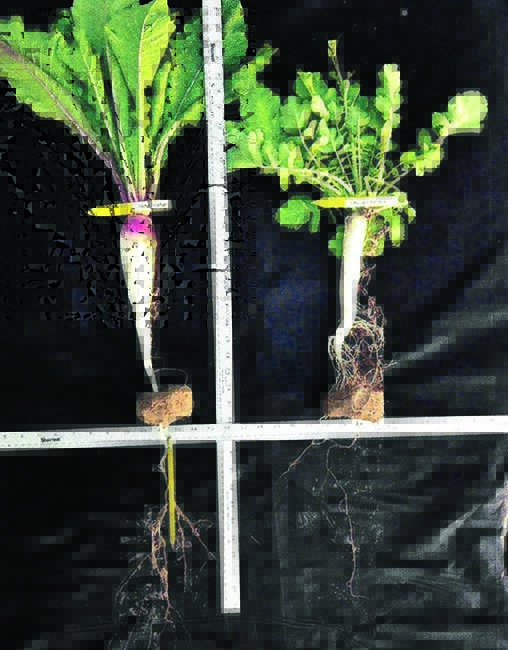
Deep-rooted cover crops act like natural soil engineers. Their roots create channels, often called biopores, that allow water, air and future crop roots to move deeper into the soil. Over time, this improves structure, drainage and overall resilience.
Breaking Up Compaction
Deep-rooted cover crops benefit your soil in several ways:
- Break up compacted layers: Strong taproots penetrate hardpan or dense soil, creating pathways for water and roots.
- Improve water infiltration: Channels formed by roots allow rain and irrigation to move deeper, reducing ponding and runoff.
- Support soil biology: Root exudates feed microbes, which help decompose organic matter and enhance soil aggregation.
- Protect future crops: Better-structured soil means easier planting, improved nutrient availability and stronger crop establishment.
Cover Crops That Dig Deep
Here are some deep-rooted cover crops we offer and why they’re effective:
- Tap-It Brassica: Our newest brassica, Tap-It, was developed to tackle serious compaction. Its exceptionally strong taproot can reach up to 36 inches in about 28 days, pushing through dense soil layers and creating channels for air, water and nutrients to move more freely. Unlike many brassicas, Tap-It’s upright growth habit allows it to work well in blends without shading out companion species.
- Twister Hybrid Brassica: Built for fast growth and high palatability. Its fast establishment and aggressive root system help improve soil structure, scavenge leftover nutrients and reduce surface compaction. As it grows, Twister captures nutrients that might otherwise be lost, holding them in place for the next crop. When terminated, its residue breaks down quickly, returning organic matter to the soil and supporting microbial activity.
- Driller Radish: Built to break through tough soils and improve how your ground handles water. Its powerful taproot “bio-drills” into compacted layers, creating channels that allow air, water and nutrients to move deeper into the profile. Along the way, it captures residual nitrogen and other nutrients, holding them in place instead of letting them leach away. When winter temperatures drop into the low 20s, Driller naturally winterkills, leaving behind residue that suppresses weeds and releases those stored nutrients back to the next crop.
- Rape: Rape (or rapeseed) is a simple, effective tool for relieving soil compaction. Its deep, aggressive taproot works like a natural biodrill, pushing through dense soil layers and breaking up plow pans that restrict root growth and water movement. Its fibrous roots help increase soil porosity and improve overall tilth. When terminated, rape adds organic matter back to the soil, supporting better structure and long-term resilience. Hardy and fast-growing, it’s a dependable option for improving compaction across a wide range of soil types.
- Cereal Rye: While not as deep as brassicas, cereal rye develops a dense fibrous root system that improves topsoil structure, reduces crusting and complements taproot crops in a mix.
- Hairy Winter Vetch: A legume with moderately deep roots, hairy vetch adds nitrogen to the soil while its roots help hold the soil and improve structure. Mixing vetch with grasses or brassicas gives you both soil-building and nutrient benefits.
Managing Deep-Rooted Covers
Selecting the right cover crop variety is just the beginning. Follow these tips to help make the most of your new crop.
- Plant early enough: Roots need time to penetrate before frost or cash crop planting.
- Mix wisely: Taproots and fibrous roots complement each other.
- Consider grazing or mowing: Livestock can help terminate covers and recycle nutrients, but don’t overdo it—too much traffic can compact wet soils.
- Plan termination: Rolling, crimping, light tillage or even selective herbicide use can prepare the field for planting without negating the benefits of your cover crops.
Making adjustments
Whether you are strengthening pastures this season or planning improvements in your crop fields after harvest, these species work below the surface to open channels, improve structure and build resilience over time.
You cannot change what happened over winter. But you can decide what happens next. If compaction showed itself on your operation, now is the time to make adjustments. The team at Missouri Southern Seed can help you select the right deep-rooted species or blends to fit your rotation, grazing plans and long-term soil goals. Give us a call at 1-800-844-1336 and let’s put a plan in place that works for your ground.
